Applications
A 42W charger sounds small next to the 1800W units we build for industrial packs. But most light electric vehicles do not need much: a scooter that travels 20 km on a 10Ah pack uses roughly 360Wh, and refilling it overnight at 42W takes about nine hours. That is exactly the use case this series was designed for.
E-scooters and e-bikes
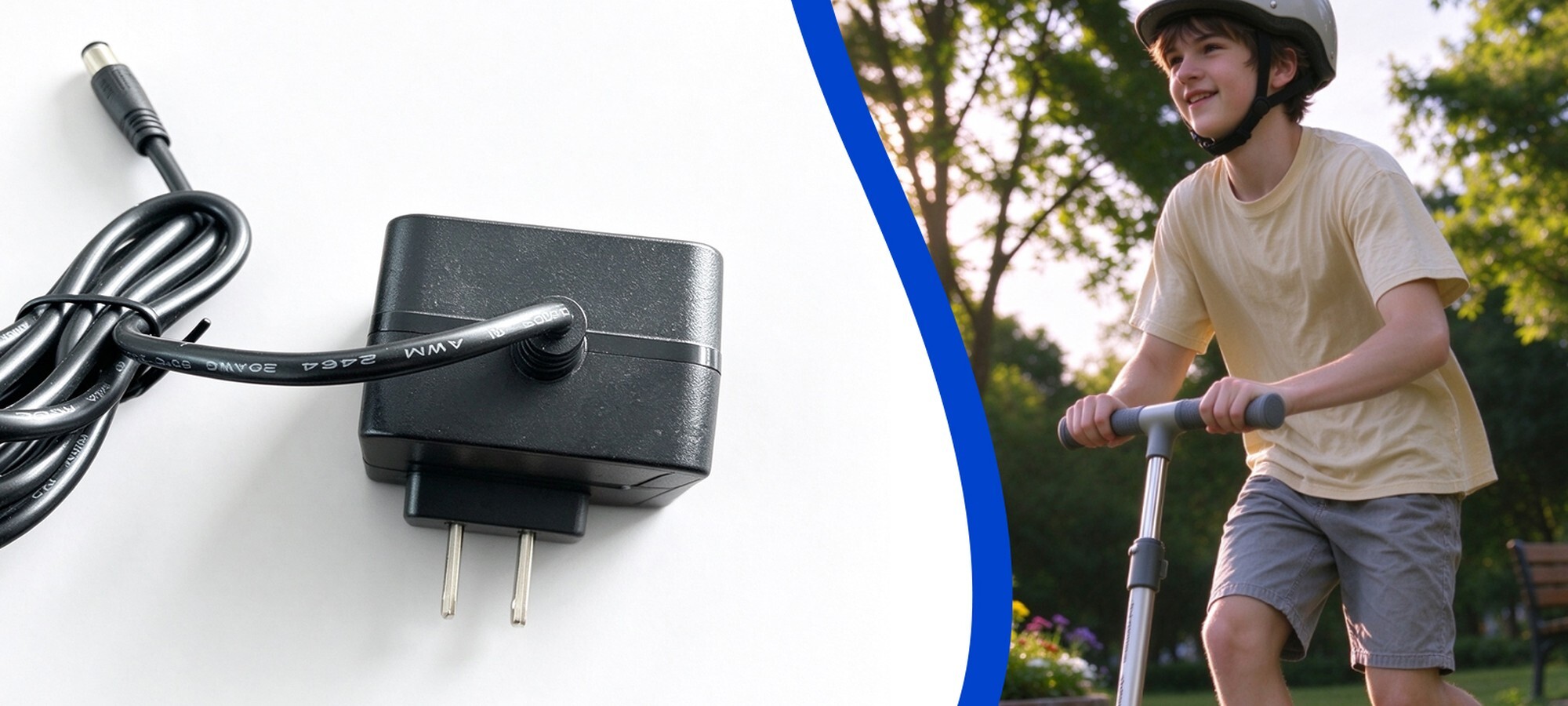
The 42.0V model is the 36V workhorse. Ten cells in series, 4.2V each, and a 5.5 x 2.1 mm port on most models. The 29.4V model covers 24V e-bikes and hoverboards, and the 25.2V and 16.8V models handle 24V boards and kids' scooters respectively.
Hoverboards, drift boards and self-balancing boards
These are almost all 7S packs charged at 29.4V, with a T-type or big-black plug. It is the single most common replacement charger we ship, because the original is usually lost or killed by a chewed cable rather than a failed board.
Cleaning machines and floor scrubbers
Commercial cleaning robots and walk-behind scrubbers run 24V packs and charge through an Anderson or XLR connector. A 1A charger is too slow for a machine that runs eight hours a day; these customers usually step up to the 180W or 250W desktop units. The 42W is the right choice for the small autonomous units.
Delivery robots, quadrupeds and humanoid platforms
Many of these run 24V or 36V packs and charge from a dock. The charger is often specified by the dock builder, which is why our connectors matter more than our wattage here: the dock has a fixed port, and the charger has to meet it.
Golf carts and golf trolleys
Electric trolleys use 24V or 36V packs with XLR or Anderson connectors. Golf carts themselves are usually 48V and need 54.6V, which is outside this series — see the 250W and 300W units instead.
Drones, lawn mowers and underwater vehicles
Battery-powered mowers and larger drones use 6S to 12S packs, and the 42W series covers the smaller end. Subsea and inspection ROVs typically need a sealed connector and a charger that tolerates a wet environment; we build those to order.
Power tools and battery packs on the bench
14.4V and 18V tool packs charge at 16.8V and 21V. The 16.8V model works for 4S packs with a barrel input, and with a copper lug or alligator clip it becomes a bench charger for custom packs.
The one rule that applies to all of them
Match the output voltage to the pack, and the connector to the port. Current only decides how long it takes. A 42W charger will charge a 36V pack of any capacity from 4Ah to 20Ah; it will simply take longer on the bigger one. Getting the voltage wrong is what damages packs, and getting the connector wrong is what causes returns.
If you are not sure which of the four models fits your vehicle, send a photo of the old charger's label and the charging port. We answer in English within one business day.
Which charger for which vehicle
| Vehicle | Pack | Charger | Model |
|---|---|---|---|
| Kids' e-scooter | 14.4V (4S) | 16.8V 1A | JY-168100 |
| 24V board, small scooter | 22.2V (6S) | 25.2V 1A | JY-252100 |
| Hoverboard, 24V e-bike | 25.9V (7S) | 29.4V 1A | JY-294100 |
| 36V e-scooter, e-bike | 36V (10S) | 42.0V 1A | JY-420100 |
All four are part of the 42W lithium battery charger series. If your vehicle uses a port that is not a 5.5 x 2.1 mm barrel, see the connector options page.